
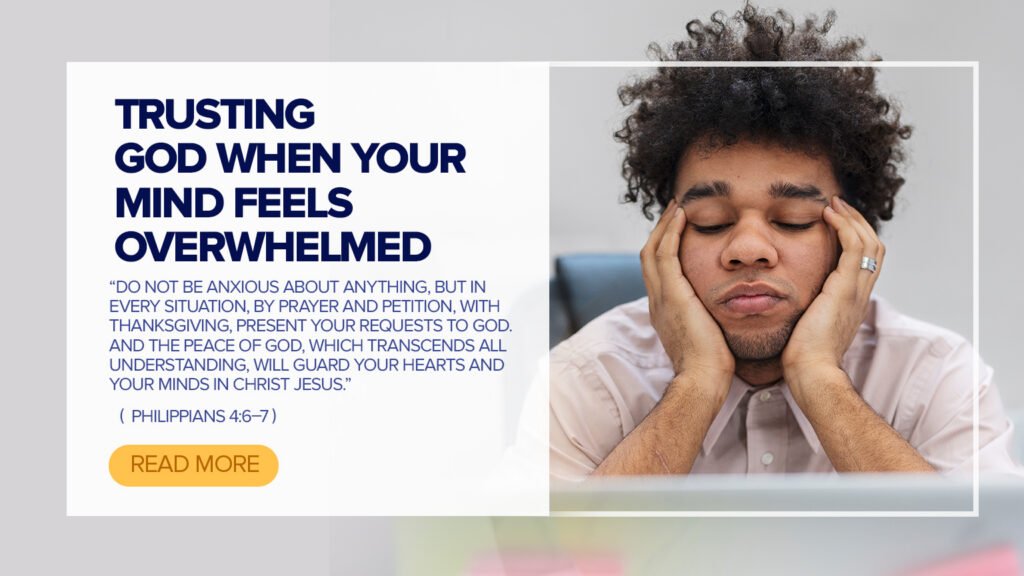
Finding peace in faith during anxious or heavy moments
“Do not be anxious about anything, but in every situation, by prayer and petition, with thanksgiving, present your requests to God. And the peace of God, which transcends all understanding, will guard your hearts and your minds in Christ Jesus.” — Philippians 4:6–7
An Honest Beginning
There are moments in life when the mind simply refuses to rest. The clock reads 2am, the house is quiet, but something inside you is anything but still. Worries arrive uninvited and queue up one after the other — about the future, about people you love, about things you cannot control and perhaps never could. You replay conversations. You anticipate catastrophes that may never come. Your chest carries a weight you cannot name, and you wonder, quietly and guiltily, whether a person of genuine faith should feel this way at all.
If that is where you are today, beloved, let this be the first thing you hear: you are not broken. You are not failing. You are human. And God, who made you with a mind capable of extraordinary thought and feeling, is not surprised by its capacity for worry. He is not disappointed in you. He is drawing near.
The Lie We Tell Ourselves
Many sincere believers carry a hidden shame around anxiety. It goes something like this: If I truly trusted God, I would not feel afraid. If my faith were strong enough, my mind would be at peace. And so the struggle doubles — not only are we anxious, but we are anxious about being anxious. We add a layer of spiritual guilt on top of an already heavy load.
But let us open the Scriptures honestly. The Psalms — those raw, unfiltered prayers of God’s own people — are saturated with anguish. “My soul is in deep anguish. How long, Lord, how long?” (Psalm 6:3). “My heart is in anguish within me; the terrors of death have fallen on me.” (Psalm 55:4). These were not the prayers of people without faith. They were the prayers of people whose faith was real enough to bring their genuine struggle before God. Honest fear carried to God’s feet is itself an act of trust.
The prophet Elijah, after one of the greatest spiritual victories in all of Scripture, collapsed under a broom bush and asked God to take his life (1 Kings 19). What did God do? He did not rebuke him. He did not lecture him on the importance of positive thinking. He let him sleep. He sent an angel to bring him food. He met him in his exhaustion with gentleness and provision. That is the God we serve.
“Anxiety is not evidence of failed faith. It is a wound that faith walks toward, not away from.”
What the Peace of God Actually Is
Philippians 4:7 speaks of a peace that “transcends all understanding.” Notice what it does not say. It does not say a peace that removes all difficulty. It does not say a peace that comes only when circumstances improve. It says a peace that guards — like a sentinel, like a soldier at the gate — your heart and mind. This peace is not the absence of the storm. It is steadiness within the storm.
Jesus said, “Peace I leave with you; my peace I give you. I do not give to you as the world gives.” (John 14:27). The world’s version of peace is contingent — it arrives when everything goes well and disappears when it does not. The peace Jesus offers is of a different nature entirely. It is not the silence of having no problems. It is the stillness of knowing that the One who holds all things is also holding you.
PRACTICAL ANCHORS FOR THE OVERWHELMED MIND
Remember What God Has Already Done
When anxiety rises, our attention narrows almost entirely to the threat in front of us. One powerful antidote is the practice of remembrance deliberately calling to mind the faithfulness of God in the past. Take a piece of paper and write at the top: “What has God already brought me through?” Let the list grow. Let it be specific. The provision that came at the last moment. The relationship that was restored. The strength that appeared when you had none left. Remembrance is not denial of the present struggle. It is the gathering of evidence that God has not changed.
Speak Truth Out Loud
The mind is powerfully shaped by what the mouth says. When anxious thoughts spin silently, they gain momentum. When they are spoken aloud — or when truth is spoken aloud to counter them — something shifts. Place your hand on your chest and say: “I am held.” Or pray the words of the Psalmist aloud: “The Lord is my shepherd; I shall not want.” Your nervous system needs to hear truth embodied, not just thought abstractly.
Return, and Return Again
Trusting God with an overwhelmed mind is rarely one grand, dramatic surrender. It is a thousand small returns. A thought spirals out you bring it back to God. Fear spikes you say a short prayer. You return. And return again. Each return, however small, is an act of faith. Do not wait until you feel ready. Come as you are, as many times as you need. He will always be there when you do.
Friend, your struggling mind is not a place God avoids. It is precisely the place He longs to enter. “Cast all your anxiety on him because he cares for you.” (1 Peter 5:7). Not some of it. All of it. He can carry what you cannot. And He is glad to.
Wherever you are in this moment breathe. You are held by hands that have never let go.